
Do DMT Experiences Reveal Other Realms of Reality?
Why consciousness appears to move from geometry to entities to universal awareness, and what that might reveal about the nature of the Universe

“I made few comments regarding people’s reports of these unseen realms. It was hard to keep up, and I didn’t know what to say. It was at this point that I began having to fight a tendency to regard these stories as dreams, or figments of their DMT-amplified imaginations. On the other hand, I also began doubting my own model for what exactly happens on DMT. Were people really somewhere else? What exactly were they witnessing?”
— Excerpt From DMT: The Spirit Molecule, Rick Strassman M.D. —
As a trained neuropsychologist, I’ve always been fascinated by altered states of consciousness, especially those in which N,N-Dimethyltryptamine (or DMT) is involved. I’ve spent years reading accounts from every corner of the altered-state landscape, and in all of these accounts one thing kept jumping out at me: the journey itself appears to have a structure, and my personal feeling has always been that psychedelic journeys tell us something not only about ourselves and our minds, but also about the type of world we inhabit. That is because across psychedelic journeys, mystical states, near-death experiences, shamanic initiations, OBEs and spontaneous spiritual experiences, people often report moving through remarkably similar stages.
- First come geometric forms: grids, lattices, spirals, tunnels and vibrating patterns.
- Then symbolic imagery emerges.
- Then coherent environments.
- Then encounters with apparently autonomous beings.
- Then some form of revelation, teaching or transformation.
- Finally comes the difficult process of returning and making sense of it all.
What I find particularly interesting is that this progression itself appears hierarchical. At the bottom you have pure structural geometry. This geometry then becomes meaningful when it evolves into symbolic imagery, which is then replaced by places and worlds, which then become populated by conscious entities. From here the experience often becomes a source of knowledge which leads to some kind of revelation. For me, this looks much less like random hallucinations or tricks of the mind, and much more like a movement from abstract information towards increasing complexity and apparent agency.
But why does consciousness seem to organise itself in this order? And what if altered states reveal layers of the interface through which consciousness organises both experience AND material reality?
The Architecture of Visionary Experience
Stage 1: Geometric and Structural Forms
Heinrich Klüver, an influential German-American biological psychologist and philosopher who brought Gestalt psychology to continental America, was probably the first to formally catalogue what he called “form constants” — the strikingly geometric grids, honeycombs, lattices, tunnels and spirals that usually signal the onset of a psychedelic experience. Modern neuroscience assigns these to retina-to-V1 mapping, in which its activation spreads in straight lines within the visual cortex.
Mathematical models find that parallel stripes of cortical firing produce concentric rings and/or perpendicular stripes that can result in a sort of tunnel-effect experience (a.k.a. the reported “light at the end of the tunnel”).
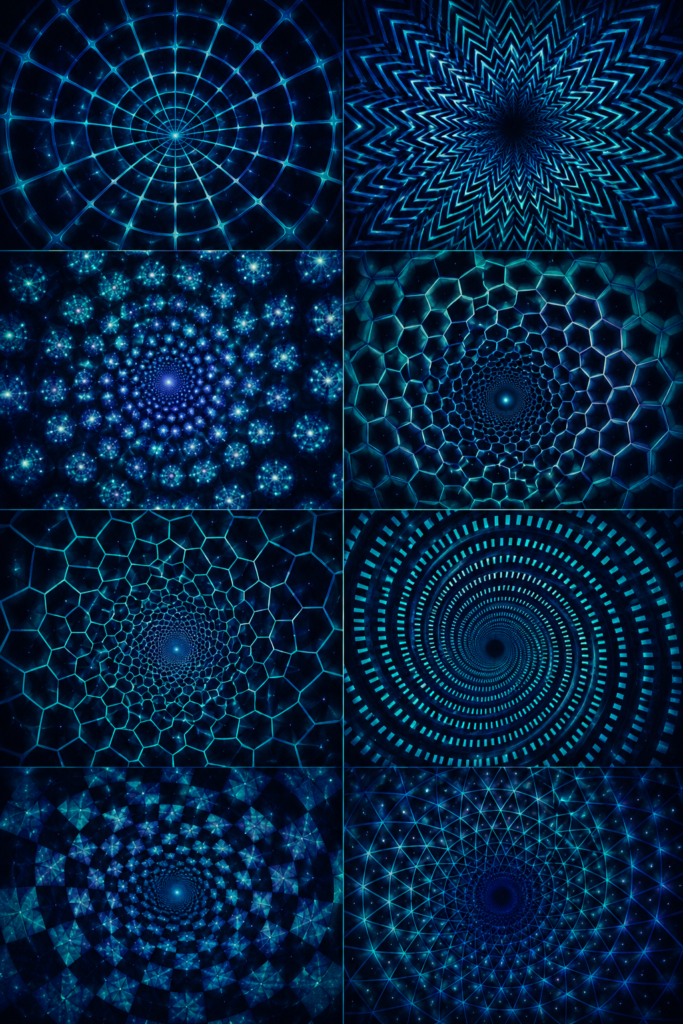
Similarly, it can also produce diagonal stripes that result in a spiral effect that exactly matches the shapes people report. In predictive-processing terms, psychedelics appear to “release” low-level visual priors, so that V1’s intrinsic Turing-like patterns are laid bare.
In other words, modern science attributes these fractal-like patterns to the basic wiring of the brain’s visual system, revealed when normal sensory filtering is dampened, and these visuals seem to come before anything symbolic because they lie at the foot of the perceptual hierarchy. In other words, the “lowest” layer of brain representation is unveiled first. But why does consciousness begin with these purely geometric structures at all? Why should the breakdown of ordinary perception first reveal form without meaning, rather than meaning without form?
Stage 2: Symbolic and Archetypal Imagery
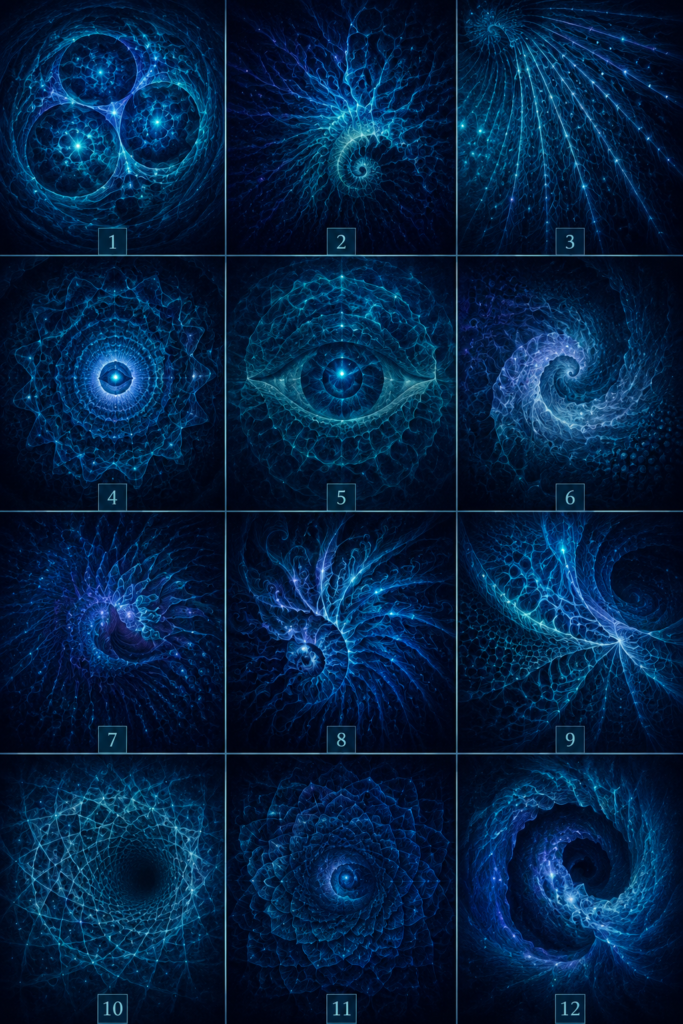
Once basic geometry floods in, the brain seems to begin to interpret it, filling in the patterns with culturally meaningful content. Mythic symbols start to emerge, often taking the form of archetypal images such as eyes, snakes, gods, ancestral figures, human faces, and mandala-like structures.
Jungian theory suggests this reflects innate structures of meaning that are, in some sense, already embedded within the psyche. In The Cosmic Serpent: DNA and the Origins of Knowledge, Narby for instance describes seeing two intertwining snakes (mirroring the DNA double helix) and notes that serpent imagery appears across shamanic traditions worldwide.
Similarly, eye- or face-like forms frequently appear, with McGovern et al. (2025) offering a predictive-processing account. They suggest these archetypes are not externally sourced entities but deeply embedded priors within the brain’s generative model of reality. On this view, psychedelics relax top-down constraints, allowing latent symbolic structures to surface as visions, characters, narratives, and mythic imagery. But this framing still leaves something unresolved. It describes how symbolic content might emerge, but not why meaning appears at all in the first place. What is it about this level of processing that causes pure geometric structure to become experience that is felt as meaningful rather than merely patterned?
Stage 3: Autonomous Environments
At a high enough intensity, the experience then usually “breaks through” into what becomes a fully formed alternate world or dimension. Research subjects describe entering what feels like other realms with hyper-dimensional planes, vast temples, alien cities or endless landscapes, although physical laws still feel consistent and coherent — so coherent, in fact, that despite its otherworldliness, participants report a state no less real than ordinary reality, likening it to a lucid dream or virtual world in which they feel truly present in their new environment.
Why so spatial, though? A plausible answer is that our brains always construct a 3D scene by default; psychedelics may simply allow the internal model free rein.

During a psychedelic experience, the hippocampal and parietal networks that normally map space remain active, only now driven entirely by chaotic neural and chemical excitation. The result is an immersive kind of “virtual reality” that often seems even clearer than ordinary reality. Functional imaging supports this: for example, DMT dissolves the brain’s normal default mode network (DMN) patterns and broadly increases connectivity, effectively letting imagination run vivid and wild. In other words, the brain under psychedelics may “simulate” a world, and we find ourselves wandering through it.
Stage 4: Encounter Experiences
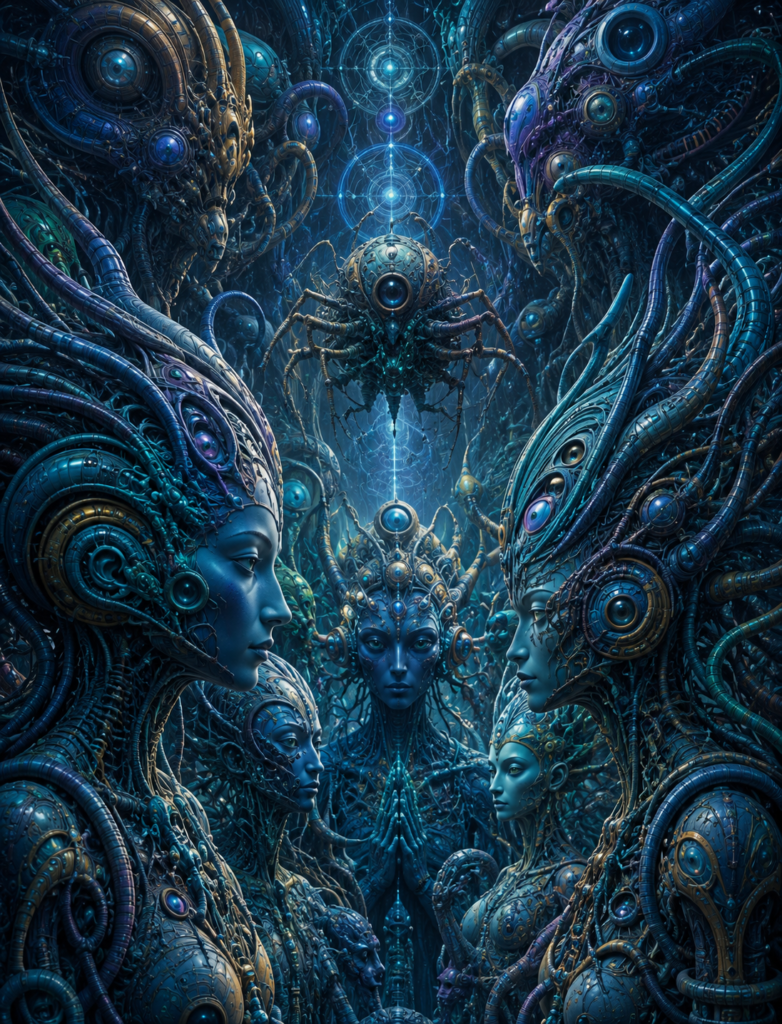
At higher doses of psychedelics, especially DMT and ayahuasca, reports frequently shift from abstract visuals and environments into encounters with seemingly autonomous “others”. In Rick Strassman’s clinical DMT studies, around half of participants described meeting entities that felt intelligent, intentional, and independent — ranging from humanoid figures to insect-like or machine-like presences. Similar motifs appear in ayahuasca research and in broader psychedelic literature, including large-scale surveys of psychedelic experiences.
Comparable “presence” or “being of light” encounters also occur in near-death experience research, suggesting a cross-contextual pattern where altered states often end up producing the experience of something that feels like an intentional being or presence (i.e. an “agent” you can interact with).
Neuroscientific interpretations tend to ascribe these kinds of phenomena to predictive processing and social cognition systems. Psychedelics are known to reduce the stability of self-referential processing and increase cross-network connectivity, which may allow normally constrained systems involved in theory of mind and agency detection to become overactive or decoupled from external input. From this point of view, “entities” could just be the brain doing what it normally does: trying to detect other minds and intentions, but turning that process inward when the usual separation between self and world breaks down. But what we still don’t understand is why this so often shows up as clear, interactive “beings” rather than vague imagery or abstract symbolism.
Stage 5: Revelation and Unity
Many psychedelic and near-death experiences end in what people describe as a peak moment of unity or insight: a feeling that everything is one, that time disappears, and that they’ve encountered something deeply meaningful or ultimately true. In the clinical psilocybin studies conducted at Johns Hopkins, for instance, a large number of participants report experiences that match what researchers call “mystical-type experiences,” including feelings of oneness, sacredness, and a powerful sense of knowing something real even if it can’t be explained in words. Similar descriptions also appear in classical philosophical and psychological accounts of mystical experience. Similar reports appear in the classic phenomenological work of Walter Stace, who described the defining feature of mystical consciousness as the “apprehension of an ultimate nonsensuous unity in all things.”
Neuroscience sometimes interprets this as the brain settling into one overall interpretation when its normal filtering and self-structure break down, leading to ego dissolution and a feeling of “oneness.” But why does this final state so often feel like a profound revelation rather than just a neutral sensation? People don’t just feel unified; they often feel they’ve discovered something absolutely real and important, and this can permanently change how they see the world.
DMT as Frequency Modulator?
DMT is the poster child for this arc because it hits fast and hard. Intravenous or smoked DMT produces the full procession of stages in mere seconds to minutes, with users often describing an intense rush of fractal visuals and tunnel effects almost immediately, and within minutes they may feel “transported” into another dimension. At peak, breakthroughs commonly involve intense contact with entities, and finally, profound insights or a sense of ultimate truth occur. Ayahuasca, which contains orally active DMT, appears to follow the same broad trajectory but unfolds more gradually over several hours. Even near-death experiences (which may involve the release of endogenous DMT) exhibit striking parallels, often involving tunnels of light, encounters with beings, and a final sense of profound understanding.
One way of interpreting the extraordinary consistency and intensity of DMT experiences is to take into consideration the fact that this molecule is not alien to us, but appears to be produced within the human body itself in trace amounts (although the exact mechanisms are still not properly understood). This raises an intriguing possibility: rather than being just another psychedelic compound, DMT may function as a kind of biological interface mechanism, temporarily altering the relationship between consciousness and reality in such a way that normally inaccessible domains of experience become directly available. And if its endogenous production does play a functional role in human neurobiology, then it is at least conceivable that it participates in boundary states of consciousness like birth, death, dreaming, and other extreme shifts in neural organisation.
This notion is to some extent shared by Dr Rick Strassman, an American clinical associate professor of psychiatry at the University of New Mexico School of Medicine. Between 1990 and 1995, Strassman conducted U.S. government-approved and funded clinical research on DMT at the University of New Mexico. Extensively documenting and reporting his findings in his book DMT: The Spirit Molecule, Strassman gathered data from 60 volunteers he injected with DMT. I am not going to rehash the book or his findings here (although I do suggest you read it), but it offers valuable insight into both the arc of reported experiences under controlled conditions and what those patterns might suggest beyond neuroscience and pharmacology.
Although I need to make it clear that Strassman never actually said, “I have proven DMT opens portals to other dimensions,” by the end of the study he did gradually move away from a conventional neuropharmacological interpretation and toward a more intriguing possibility: that DMT may function as a kind of receiver-modifier that allows access to realities that are normally unavailable to ordinary consciousness. In other words, the brain does not simply manufacture experience under the influence of DMT, but rather DMT alters the “tuning” characteristics of the system, in much the same way a television receiver shifts between channels on a screen. This shift, in turn, may actually allow consciousness to access other “channels” of reality — parallel universes and non-material realms populated by other intelligences.
DMT as Biological Key to the Hologram?
What I find striking in the reported phenomenology is not simply the intensity of the imagery, but the repeated sense of transition into what feels like another domain entirely: structured environments, intelligent presences, and communicative encounters that are experienced as autonomous rather than imagined. These are not typically described as symbolic or metaphorical constructs by participants, but as genuine encounters with “something there”, as if consciousness has shifted into a different register of reality rather than simply generating internal imagery, which makes me wonder if DMT is acting as more than a hallucinogenic compound in the conventional sense.
Following this line of reasoning, if the brain functions less as a generator of consciousness and more as a receiver or tuning device, then ordinary waking awareness may represent only one channel within a much broader spectrum of existence. Under normal circumstances, the brain filters and stabilises experience, collapsing a vast sea of possibilities into the coherent physical world we inhabit. DMT may loosen those constraints, allowing consciousness to tune into levels of reality that are normally inaccessible.
In a holographic universe, reality is fundamentally information organised across multiple layers or frequencies. What we perceive as solid matter may simply be one band within a much larger spectrum. The recurring reports of geometric structures, autonomous realms, non-human intelligences, and ultimately universal consciousness could therefore represent consciousness navigating different levels of the hologram itself. The remarkable consistency of these experiences across individuals, cultures, and historical periods suggests that something more than personal fantasy may be taking place.
From this perspective, DMT may act like a kind of biological key, a mechanism through which consciousness can temporarily shift its point of access within the holographic structure of reality. The worlds encountered in these states are thus not necessarily imaginary, instead being domains of reality that coexist with our own but remain hidden behind the narrow frequency band of ordinary perception.
Whether this interpretation is correct remains an open, but in my opinion, interesting question. If consciousness is fundamental, if reality is holographic, and if the brain functions as a filtering and tuning system, then DMT may provide something far more significant than a psychedelic experience. It may offer a glimpse behind the interface itself, revealing that what we call reality is only one layer within a much larger multidimensional landscape of consciousness.
This essay draws on ideas from my books Living in a Quantum Reality and Consciousness and the Cosmic Hologram. For a deeper exploration of these ideas, consider purchasing your copy. To support the work you can subscribe to my Substack, or make a small donation.
Lieze Boshoff is an author and researcher exploring consciousness, metaphysics, and anomalous experience through the lenses of contemporary science, psychology, and philosophy. With a background in clinical psychology, neuropsychology, and doctoral research on consciousness and perception, her work examines reality as a participatory, holographic field in which mind and matter are inseparable. She writes at the intersection of science, symbolism, and the unseen, investigating how experience itself shapes the cosmos we inhabit.
DISCLAIMER: Every essay published here reflects my own research, ideas, analysis and judgement. I occasionally use an AI grammar tool as an editorial assistant to improve grammar and structure, much as authors have long worked with human editors. Every substantive argument, interpretation and final editorial decision remains my own.