
Magic in a Consciousness-First Holographic Cosmos
How information theory & quantum physics infer interwoven & meaningful relationships between mind & matter that can be discovered, contemplated & Utilised.

“In the beginning there precipitated out of the void nothing but a matter that was finer and more subtle than light, then an exceptionally fine gas. If a human eye had been looking at the dawn of history it would have seen a vast cosmic mist. This gas or mist was the Mother of All Living, carrying everything needed for the creation of life.”
— Excerpt From The Secret History of the World, Mark Booth —
For current mainstream science, first there was a big bang from which matter emerged, and only then, eventually and quite inexplicably, consciousness managed to rear it ephemeral head, apparently for no apparent reason other than to confound the minds of many of the intellectual luminaries who have been pondering its very nature over the last couple of millennia. This matter-first universe sounds neat, but the thing is that it doesn’t really make sense. It doesn’t explain how something that isn’t conscious can experience what it is like to be conscious?
Modern science is really good at describing things from the outside. It talks about particles and forces and fields and interactions, but it completely fails to talk about the inside experience, the “what it feels like to be” something, whether a person, a cat, a bat, or even a river. It just assumes that something unconscious can eventually produce consciousness from nowhere. That dead, mindless things can somehow organise itself into first-person experience — and not just behaviour or intelligence, but actual inner awareness.
Unlike science’s predominant materialist (or mind from matter) view of consciousness, the majority of idealist esoteric and occult traditions teach that it is, in fact, matter that emerges from mind. That we actually live in a consciousness-first universe, and that reality is structured as interconnected spheres or orders of existence bound together by networks of meaningful relationships or correspondences. What appeared in the heavens were reflected on earth, the cosmos was echoed in the human body, and the natural world revealed spiritual wisdom.
For most of Western history, these correspondences were understood as evidence of an underlying unity, hidden clues to the structure of reality, that made the universe intelligible. They were expressions of the conviction that our world is composed of interconnected levels of consciousness which participate in a common order that reflects on another through patterns of similarity and analogy — that beneath diversity is concealed an underlying unity — and that these relationship could be discovered, contemplated and utilised.
Footnotes on Information Theory
Before we get into the nitty gritty of a consciousness-first holographic universe, it’s useful to understand some fundamental concepts within information theory. It will not only help to explain a few of the concepts and ideas that I will talk about later, but it also provides a scientific basis for the framework I’m suggesting (this is ◦ wyrd ◡ science ◦ after all!).
From the standpoint of information theory, our world, as we sense and experience it anyway, consists of three building blocks:
- matter in all its various modalities
- energy in all its forms and;
- information in all its variants
Science has been really good at using information to describe the nature of micro-level things such as quantum systems, elementary particles and computer science. But information is also important when trying to understand bigger things, like living organisms, and macrostructures such as planets, and galaxies of the Universe.
For instance the so-called “Big Bang” and the events that followed, appear to constitute a fine tuned expansion process, in the framework of a very specific set of interrelated physical laws and constants (Davies, 2004, Greene, 2004, Linde, 2004, Görnitz, 2012). In this sense the evolution of our universe can be seen as a dynamic flow of unfolding information and creation of new information.
It gets complicated, and I don’t want to go into too much detail here, but what they argue is:
- a basic perception of nature as a whole is only possible if a collective memory is available, which argues for some kind of universal knowledge domain.
- in principle, consciousness can be perceived as processing of information.
- since consciousness is observed in literally all the aspects of evolution, consciousness should have a universal character and must be present at each level of the cosmos.
In fact, for some Information Theorists, information is as fundamental as matter and energy in the fabric of reality. That information is, physical and may even represent a modality of physics that preceded the manifestation of matter (Wheeler, Zeilinger).
And now we can get to the good stuff…
We’re Living in a Holographic Universe
From the birth of our universe until its eventual demise, information will flow continuously flow throughout it. It’s its ontological state and can be seen in everything form biological process to cultural and scientific evolution. This does not happen in a time-linear fashion, but should rather be seen as a chain of feed-back loops where existing information is processed, and where new information is generated and integrated.
In other words:
- primary information was present a priori at the start of our universe gradually unfolded over time
- new information that arises in the ongoing process of universal entropy
- converging information is potentially induced by a state of equilibrium to which all other states converge (what is called an attractor)
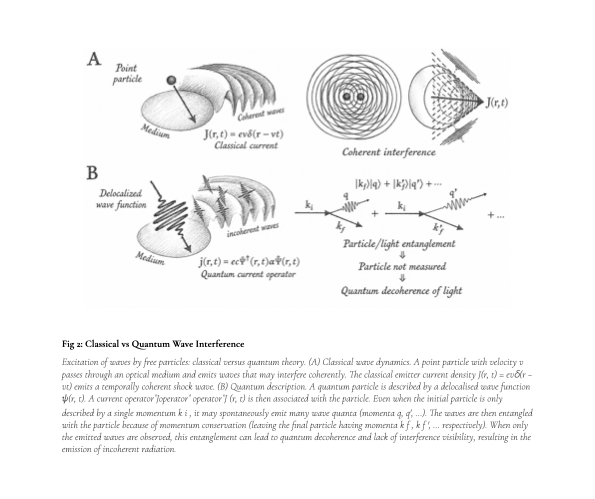
And this is where things get interesting because the interference of new information and converging information, can be seen as a holographic process, in which these two types of information, interacting in a two-dimensional space, are converted to a three-dimensional image.
Important to understand here though, is that a hologram isn’t a “normal” image but 1) an interference pattern from which structure emerges, 2) it is fractal in nature with each iteration containing the information of the whole holographic picture, and 3) holographic clarity depends on the density of overlap (coherence).
The Holographic Universe is Also A Consciousness-First One
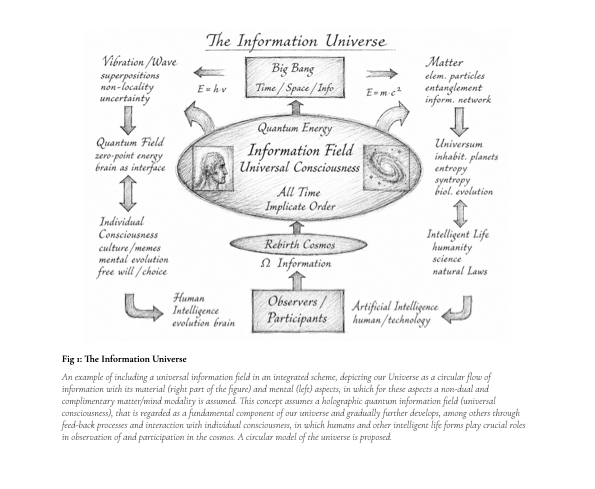
When we translate this structure into a consciousness-first model, it is the unfolding (a priori) information that is the basis of this holistic aspect within the hologram. This universal information field pervades all non-living and living elements of the universe and is also what forms the fundamental binding element in the universal information matrix and what gives rise to the creation of form in both matter and mind (Fig. 1).
Implicit in this concept is that, through entanglement and resonance, matter (that according to quantum physics exists as both wave and particle) form an active information matrix that constantly unfolds and creates new information that gets collected in an all pervading knowledge field. A field that from the very beginning of our universe acted as a dynamic source of change and experience (the latter used here as a metaphor, such as proposed by Whitehead as the most fundamental creative element of the Universe).
Providing further structure to this framework was the introduction by Von Neumann in 1963 of an “ontological” quantum physics approach to information theory. Here the role of the observer and the measurement instrument in the operation of the system is brought together. Stapp (2003) described Von Neumann’s view of quantum theory through a simple definition: “the state of the universe is an objective compendium of subjective knowings”.
The implication here is that the state of the universe can be seen as a representation of a universal wave function — a superposition of all the wave functions — that conscious beings collapse through observations. In this sense the universe becomes a sum of subjective thoughts, intentions and acts, albeit a collectively objective one. In other words, the physical aspect of reality (as so eloquently described by Schrödinger equation) can be seen as a sort of compendium of subjective knowledge that collapses into the consensus reality in which we live. It may even be that the conscious act of asking questions on the very nature of reality is what drives the actual evolution of the universe!
Further, quantum theory suggests that these interactions between particles, like photons and electrons for example, can also be described as wave interferences that produce novel resonance patterns in the form of superpositions. To get even more specific: matter, at its most basic level, may exists in a sort of web of mutual relations that can be seen as a system of resonance patterns (as per String/M theories).
In Decoding the Universe, Charles Seife explains this (albeit a bit convolutedly!) brilliantly:
”What is it that gathers information about the atom and disseminates it into the surrounding environment: it is nature itself that is constantly making measurement on everything. The particles of light and air are nature’s probes or measuring devices. By observing an object you are simply receiving the information that has already be deposited on those particles. Even if you would remove the earth atmosphere and our sun distant photon’s from distant stars are bombarding our planet. The universe is teeming with cosmic rays that are composed of photons that were born shortly the big bang. Even without any of those photons, nature would be able to collect information since it creates its own particles at every point of space: on the smallest scales, particles are constantly winkling in and out of existence in the quantum vacuum or zero-point energy field. They appear, gather information, disseminate it into the environment and disappear into nothingness from whence they came. These evanescent are the so called vacuum fluctuations occurring throughout the universe, and make it impossible to shield an object completely from Nature’s measurements”.
The vacuum domain or zero-point energy field (ZPE) that Seife talks about here is what some people think it might be a possible source of nature’s collective memory, and which is considered to be a kind of Universal Consciousness (see Laszlo, 2011, Meijer 2012 & 2013) that may be structured as a holographic system.
Within such holographic system, these resonance patterns can either amplify or annihilate each other in a way similar to how waves on water behave. Where two peaks or troughs meet, they become more coherent, and where waves of opposite forms collide, they cancel each other out. Within a holographic universe, resonant patterns of high coherence create image projections that appears solid, persistent, and external. Where resonant patterns have low coherence, the clarity of the projected image is poor and appears weak or even non-existent
Material Reality & Nested Layers of Coherence
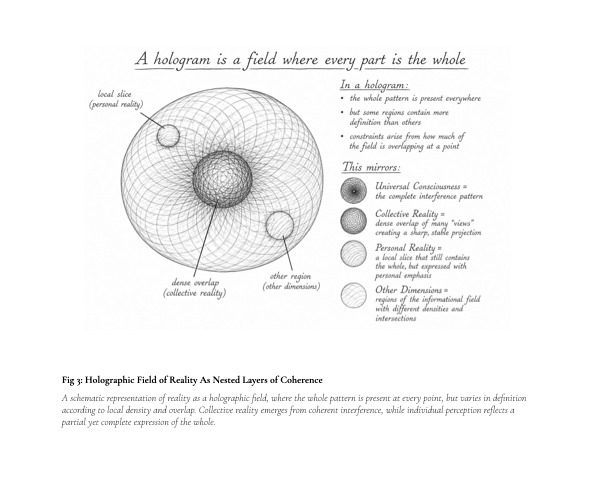
Within this holographic universe framework, material reality can best be understood as layers of nested coherence. And, although they may seem hierarchical at first, it is important to understand that this is not the case. They are the same field resolving at different scales of density. Each layer contains the others. Each layer influences the others. Each layer expresses the same underlying structure, just to a different degree of projected image resolution.
What is cool about this is that there is no need for competing realities.
So, right at the cosmic scale — at the level of the universe as we’ve explored it up to now — there are non-local patterns of coherence. This is where the structure of the projected holographic image isn’t bound to any immediate sensory agreement, but follows different phase relationships. This is also where, at its foundation, we find the a-priori primordial consciousness | information field that preceded it, and from which matter and energy emerge.
It is the totality of all resonance patterns that exist in a state of potential and probability (as per quantum theory’s wavefunction), and where the whole is present at every point. I consider this what the ancients often referred to as the primordial aether, ocean, gas or mist that carried everything needed for the creation of life.
At another scale, we find another layer where there are shared patterns of coherence. Here the overlapping of many local systems create a projected holographic image that is clear and stable. This is also where we find the collective consciousness, and where we see the interference of new information and converging information to creating a collective reality.
It is the same field, just expressed at a different density. We will still find the whole, now just expressed within a shared location within a specific layer of the universal hologram, with shared localised patterns of resonance created by billions of localised expressions of consciousness(es) through a collection of conscious perceptions, intentions, and stabilised assumptions.
At yet another scale, we can find a layer of local coherence where the patterns are generated by an individual consciousness, and the projected holographic image forms a stable experiential world for that individual. Again, it is a localised pattern of resonance, this time however, it is created by a single, localised expression of consciousness that creates personal reality and the individual experiences, perceptions, and phenomenological aspects of individual mental lives (qualia).
And, at yet another scale, we find what are sometimes described as “other dimensions” which can be reframed in this model as regions of the same field, just with different interference conditions, different densities, different phase relationships, different modes of coherence. Nothing needs to be added outside the system for these distinctions to make sense. It is all variations of structure within a single field.
Why Reality Feels Fixed
As we’ve explored, interactions between particles like photons and electrons for example, can also be described as wave interferences that produce novel resonance patterns in the form of superpositions, and that matter, at its most basic level, exists in a sort of web of mutual relations that can be seen as a system of resonance patterns. Within such holographic system, resonance patterns of high coherence create image projections that appear solid, persistent, and external. Where resonant patterns have low coherence, the clarity of the projected image is poor and appears weak or even non-existent.
And herein lies the rub. Because, in a holographic system, the stability of reality is not a property of solidity, but of coherence (subtle but important difference), and the more overlapping waveforms there are at a certain point in space and time, the more coherent it is (i.e., the more they reinforce a pattern). It also becomes more resistant to change.
So, what we call the physical world or material reality feels fixed because it is an example of a region of extremely high coherence resulting in a the projected holographic image is very clear and very stable. It is also continuously reinforced by the consciousnesses emanating from billions of collective and shared perceptions, intentions, beliefs, and physical interactions. That density produces what we experience an objective material reality precisely because it is heavily stabilised.
This is also why change within such a system is constrained. It is not that reality refuses change in principle. It is that change requires shifts in coherence at multiple levels simultaneously.
Individual & Collective Reality Creation
The philosophical question now usually arise: If consciousness is fundamental and multiple conscious agents exist, then whose reality is real? In a holographic model, that question sort of become moot because no single point generates the whole. Every point contributes to it. However, with that said, influence is not evenly distributed. As we’ve seen, patterns that align across many nodes of the field are more coherent, and therefore a exert more stabilising force than isolated ones.
In other words, as discussed in Part I, local coherence produces personal experience while shared coherence produces collective stability. When patterns align, their influence scales. When they don’t, they remain local. And this is why reality is simultaneously both shared, but not identical.
In practical terms, if we compare our shared collective consensus reality to that of our personal reality, the first is a region where alignment is strongest because it has many more overlapping waveforms that produce a much more stable and dense state of coherence, than that of personal reality with its sum total of one node. This is also why experience feels both personal and shared at the same time. You are never outside the field, but you are never identical to its full resolution either. You are a local expression of a global structure.
So reality is not created individually. It is collectively stabilised through overlapping coherence.
Magic & Manifestation in Structured Reality
Within a consciousness-first holographic universe framework, what is traditionally called magic is nothing more than a mode of interaction with coherence. In other words, magic is the deliberate, focussed alignment of attention, intention, and symbolic structure with resonant patterns in order to generate and manifest coherent states within the hologram. This in turn will create a localised region of coherence where the patterns are generated by the magician (aka an individual consciousness), and the resulting projected holographic image forms a stable reality for him or her. In other words, the magician isn’t commanding nature — they’re aligning with deeper structure already present in the hologram in order to cause change to occur in conformity with will.
None of this requires supernatural assumptions. It is is simply a model of how structured attention interacts with structured reality as functional mechanisms for shaping coherence. And once reality is understood as a responsive interference field, manifestation stops being an anomaly and becomes a specific mode of interaction with structure.
Intention & Responsiveness
In this framework, magi and manifestation is the science and practice at the intersection between structured reality and focussed attention and intention, where change occurs in conformity with will, not through force, but through alignment.
From this we can see that it is important to understand that intention does not directly generate outcomes. It generates a coherent internal state from which certain patterns become more resonant with the surrounding field of resonance patterns that exist within the hologram. That resonance increases the probability of corresponding expressions within experience, and reality becomes ontologically responsive at the level of pattern and probability, not command.
Intention does not force reality into shape, instead it reorganises the individual into a state of coherence, that state of coherence that is what allows alignment with existing structures in the field, and that alignment is what manifests changes in the “real world”.
Reality is ontologically responsive at the level of pattern and probability ⟶ Intention reorganises the perceiver into coherence ⟶ Coherence allows resonance with existing structures.
This is why participation matters even when it is unconscious. You are always already in interaction with the system. The difference between unconscious participation and deliberate practice is not whether influence occurs, but whether coherence is being shaped intentionally or by default conditioning.
Magic & manifestation, then, is best understood as the applied discipline of coherence where focussed attention and intention, and structure are brought into alignment such that change occurs in accordance with will, not as domination of reality, but as resonance with it.
Reality Inertia
For most of us, most of the time, magic and manifestation is a subtle thing that and can feel quite ephemeral and fragile. That is because of the stability inherent in reality. As we’ve discussed, the more coherence, the more stability. So even though reality reacts to focussed attention and intention, it is also highly elastic, fully interconnected, and it likes to retain and maintain this stability through a kind of reality inertia.
So, when I perform magic, (aka, apply focussed attention and intention in one area of the universe in order to affect and manifest change), it warps and shapes a bit of the reality in that localised region for me. But then, somewhere else, you perform manifestation (aka, apply focussed attention and intention in your area of the universe in order to affect change) it warps and shapes a bit of the reality for you. But, because of the consensus created by the attention and intention of the collective, reality kind of pushes back to repair that warp to maintain it’s original shape, as well as the status quo.
These rebound effects are interestingly enough observed repeatedly in psi experiments studying what they call force of will (Radin, 2018). They’ve been variously labeled a “balancing” effect, a “differential” effect, a “release of effort” effect, and a “statistical equilibrium” effect.
So, reality is fixed because it is densely coherent, seemingly also preferring stability of chaos, and it’s also apparently highly adept at self-repair.
A Note on the Framework
The ideas explored in this article are based on a perspective I have developed across several previous essays and in my ebooks; what I call the conscious holographic universe. Rather than viewing consciousness as something produced by the brain, this framework treats consciousness as a fundamental aspect of reality, one that participates in the unfolding of the world rather than merely observing it.
In a consciousness-first holographic universe, reality is less like a collection of separate and fixed objects and more like an evolving field of possibilities where matter, mind and information are different expressions of a deeper underlying process. In other words, consciousness participates in shaping which possibilities become actual through attention, meaning, intention and interaction.
This is not a claim that thoughts magically override the laws of nature. Rather, it suggests that consciousness and the world exist in a reciprocal relationship. We influence reality, and reality influences us, in an ongoing process of participation. This shift in perspective changes what many ancient and esoteric ideas appear to be, where rituals become more than empty ceremony, symbols more than decorative metaphors, and myths more than stories. Practices developed by the ancient mystery schools, shamans, gnostic traditions, and esoteric philosophers begin to look less like superstition and more like attempts to understand, and deliberately engage with, the relationship between consciousness and reality.
The purpose of this article is not to prove that broader framework but to simply explore one implication of it. If you’d like a more detailed explanation of the participatory model of consciousness and reality, you can read my essay Cosmic Consciousness and the Holographic Universe. For the wider context and the ideas that connect all of these topics, you’ll find a much deeper exploration in my Consciousness and the Cosmic Hologram: The Role of Consciousness in the Creation of Matter, Structure & Reality in a Holographic Universe.
Explore a growing library of works designed to help you understand how attention, intention, and structure interact so you can move from passive observer to conscious participant in how your reality unfolds. To support the work you can subscribe to my Substack, or make a small donation.
Reference List & Further Reading
- Davies P C W (2004). Quantum fluctuations and life. Available on: arXiv:quant-ph/0403017
- Greene B (2004). The Fabric of the Cosmos. About the Search for the Theory of Everything, The Spectrum, Utrecht.
- Görnitz T (2012). Quantum Theory as Universal Theory of Structures – Essentially from Cosmos to Consciousness, Advances in Quantum Theory, Prof. Ion Cotaescu (Ed.), ISBN: 978-953-51-0087-4, InTech, Available from: http://www.intechopen.com/books/advances-in-quantum-theory/quantum-theory-as-universaltheory-of-structures-essential-from-cosmos-to-consciousness
- László, E. (2007).The Akashic Field. New York: Dutton
- Laszlo, Ervin. “The connectivity hypothesis: Foundations of an integral science of quantum, cosmos, life, and consciousness.” (2010): 1-156.
- Linde A (2003). Inflation, Quantum Cosmology, and the Anthropic Principle, in Science and Ultimate Reality: From Quantum to Cosmos, honoring John Wheeler’s 90th birthday. Barrow JD, Davies PCW and Harper CL eds. Cambridge University Press.
- Meijer D KF (2012). The Information Universe. On the missing link in concepts on the architecture of reality. Syntropy Journal, 1, pp 1-64
- Meijer D K F (2013). Quantum modeling of the mental state: the concept of a cyclic mental workspace. Syntropy Journal, (1), pp 1-41
- Seife C (2006). Decoding the Universe. How the new science of information is explaining everything in the cosmos, from our brains to black holes. Penquin books, New York.
- Stapp HP (2009). Mind, Matter and Quantum Mechanics, Berlin-Heidelberg: Springer-Verlag.
- Stapp, HP (2012). Reply to a critic: Mind efforts, quantum zeno effect and environemental decoherence. NeuroQuantology,10: 601-605
- Wheeler J.A. (1990). Information, physics, quantum: the search for links. Complexity, Entropy and the Physics of Information. Zurek, W.H., Ed.; Addison-Wesley, Redwood City, 3–28.
- Whitehead, A.N., (1929) Process of Reality. Macmillan, London.
- Whitehead, A.N. (1933) Adventure of Ideas, Macmillan, London.
Lieze Boshoff is an author and researcher exploring consciousness, metaphysics, and anomalous experience through the lenses of contemporary science, psychology, and philosophy. With a background in clinical psychology, neuropsychology, and doctoral research on consciousness and perception, her work examines reality as a participatory, holographic field in which mind and matter are inseparable. She writes at the intersection of science, symbolism, and the unseen, investigating how experience itself shapes the cosmos we inhabit.
DISCLAIMER: Every essay published here reflects my own research, ideas, analysis and judgement. I occasionally use an AI tool as an editorial assistant to improve grammar and structure, much as authors have long worked with human editors. Every substantive argument, interpretation and final editorial decision remains my own.